
2026 Best Yanmar Generator Types for Global Buyers
Choosing the right yanmar generator in 2026 requires more than comparing power ratings and prices. Global buyers must examine operating conditions, fuel availability, maintenance access, noise limits, and local electrical standards. A unit suited to a coastal workshop may perform poorly on a remote construction site. The difference often appears during the first difficult week, not during a showroom demonstration.
This guide introduces the main Yanmar generator types available for international applications. It considers compact portable units, standby systems, commercial models, and heavy-duty solutions for demanding environments. Each category serves a different purpose. Output stability matters for sensitive equipment, while engine durability matters for long working hours. Service support matters even more when replacement parts must cross borders.
Real experience also exposes uncomfortable details. A larger generator is not automatically the better investment. Oversizing can increase fuel waste, while undersizing may create damaging overloads. Product specifications can look impressive, yet installation quality often determines actual performance. Buyers should verify voltage, frequency, phase configuration, emissions requirements, warranty coverage, and technician availability before ordering.
Conditions vary widely.
The recommendations ahead use practical selection principles rather than promotional claims. They are designed to help importers, contractors, farmers, marine operators, and facility managers compare options responsibly. However, no general ranking can replace a site assessment from a qualified professional. Load calculations, climate conditions, altitude, enclosure requirements, and local regulations may change the final choice. A careful decision may take longer, but it usually prevents expensive surprises after delivery.
Yanmar Generator Basics for Global Buyers in 2026
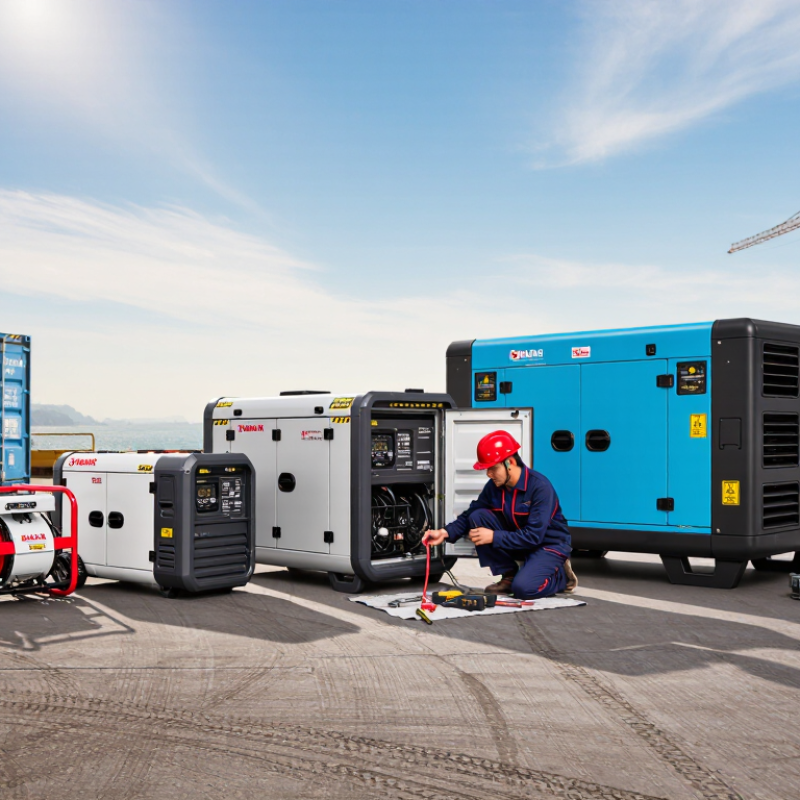
For global buyers in 2026, generator basics begin with the load, not the advertised engine size. A 100 kVA set may suit a workshop, yet motor starting can demand several times its running current. List every load, including pumps, compressors, heaters, and future expansion. Then separate prime, standby, and continuous duty. Prime power supports variable loads, while standby covers outages. Continuous duty requires steady operation. The distinction affects fuel use, service intervals, and equipment life. Measure twice.
Frequency and voltage must match the installation. A 50 Hz system cannot simply replace a 60 Hz unit without checking motors and controls. Confirm phase, neutral arrangement, breaker capacity, and automatic transfer compatibility with a qualified local electrician. Ambient conditions also matter. At high altitude or 40°C heat, available output may fall. Ask for derating tables, sound data, emissions documents, and factory test records. Do not rely on a sales image; terminal access and enclosure design affect daily maintenance.
A dependable purchase includes parts access, trained technicians, manuals, and a clear warranty process in the destination country. Check fuel guidance, battery condition, coolant level, and scheduled oil changes. Coastal sites need stronger corrosion protection. I would request a witnessed load-bank test before shipment, although buyers sometimes skip it to save time. That saving can become an expensive lesson. One overlooked detail remains common: the site needs adequate ventilation and exhaust clearance, not merely a larger generator. Review the installation drawing before ordering.
2026 Best Yanmar Generator Types for Global Buyers - Yanmar Generator Basics for Global Buyers in 2026
| Generator Type | Typical Application | Typical Power Range | Operating Rating | Configuration | Key Buyer Considerations |
|---|---|---|---|---|---|
| Standby Generator | Emergency power for homes, offices, retail sites, and public facilities | Approximately 5–2,000 kVA | Short-term backup operation during utility outages | Single-phase or three-phase; automatic transfer switch commonly used | Check transfer time, starting performance, fuel storage, noise limits, and local emissions rules |
| Prime Power Generator | Remote sites, construction projects, agriculture, rental fleets, and areas with unreliable grids | Approximately 10–3,000 kVA | Variable load operation for an unlimited number of hours, subject to the manufacturer’s load profile | Usually three-phase for commercial and industrial loads | Evaluate average load, peak load, duty cycle, altitude, ambient temperature, and transport requirements |
| Continuous Power Generator | Long-duration operation for isolated grids, mines, large farms, and industrial facilities | Approximately 50–3,000 kVA | Constant load operation for extended periods | Three-phase alternator with fixed-frequency output | Confirm continuous rating, cooling capacity, fuel logistics, synchronization needs, and service access |
| Portable Generator | Small construction tools, temporary events, emergency household loads, and field service work | Approximately 1–100 kVA | Intermittent or short-duration operation | Single-phase or three-phase; wheel-mounted or skid-mounted options | Prioritize weight, fuel consumption, outlet type, weather protection, grounding, and mobility |
| Silent or Enclosed Generator | Hotels, hospitals, offices, residential areas, schools, and noise-sensitive sites | Approximately 10–2,000 kVA | Standby, prime, or continuous operation depending on the engine and alternator rating | Acoustic enclosure with ventilation and exhaust treatment | Compare sound pressure levels in dB(A), ventilation design, enclosure corrosion protection, and service-panel access |
| Trailer-Mounted Generator | Road construction, disaster response, outdoor events, and temporary industrial power | Approximately 20–1,000 kVA | Temporary standby or prime power | Road-towable chassis, lifting points, and weatherproof enclosure | Verify trailer regulations, axle load, braking requirements, site access, and connection equipment |
| Automatic Synchronizing Generator Set | Data centers, factories, hospitals, commercial buildings, and microgrids | Typically 500 kVA and above, depending on the installation | Standby, prime, or continuous operation with load sharing | Multiple generator sets connected through paralleling switchgear | Assess redundancy, load-sharing controls, protection settings, black-start capability, and commissioning expertise |
| Low-Emission Generator | Urban projects, regulated industrial zones, ports, and environmentally controlled facilities | Available across small, medium, and large power classes | Rating depends on the engine, after-treatment system, and operating profile | Diesel engine with emissions-control equipment where required | Match the engine certification to the destination country, fuel quality, operating altitude, and permitted exhaust limits |
Select capacity using running load, motor-starting current, future expansion, and the required power factor—not only the sum of nameplate ratings.
Global markets commonly use 50 Hz or 60 Hz. Confirm frequency, voltage, phase, and connection standards before ordering.
Fuel quality, ambient temperature, altitude, humidity, dust, and ventilation can affect output, reliability, and maintenance requirements.
Review local electrical, emissions, noise, grounding, fire-safety, transport, and installation requirements before final specification.
Related Posts
-
How to Choose the Best Yanmar Generator?
-
Why Choose a Yanmar Generator for Global Power Needs?
-
Why Choose Yanmar Generators for Your Power Needs?
-
How to Choose the Right Yanmar Generator for Your Power Needs in 2025
-
What are the Best Yanmar Generators for 2026?
-
10 Essential Tips for Maintaining Your Yanmar Motor: Maximize Performance!