
Why Choose Button Cell Battery for Global Sourcing?
Why Choose Button Cell Battery for Global Sourcing?
Global sourcing decisions increasingly depend on compact power, stable supply, and documented safety. The Button Cell Battery supports watches, medical monitors, key fobs, sensors, and small consumer electronics. IDC’s Worldwide Quarterly Wearable Device Tracker reported approximately 537 million wearable device shipments in 2024. That volume creates sustained demand for dependable miniature batteries. Every shipment may contain a device smaller than a palm, yet its battery must deliver predictable voltage for months.
The opportunity is practical. Button cells offer high energy density, low weight, and efficient space usage. Their standardized formats also simplify product redesigns and international procurement. However, specifications can vary between brands, even when dimensions appear identical. Check chemistry, nominal voltage, discharge behavior, shelf life, and operating temperature. Small details matter.
Grand View Research’s battery market analysis identifies consumer electronics and medical applications as important growth areas for miniature battery demand. Meanwhile, IEC 60086 standards provide a recognized framework for primary battery dimensions, performance, and safety testing. These references strengthen supplier evaluation, but they do not replace independent verification. A certificate alone is not enough.
The case is not perfect. Lower pricing may conceal inconsistent capacity, weak traceability, or excessive packaging. Global buyers should compare samples, audit production records, and confirm transport documentation. UL Solutions also emphasizes controlled testing and safe battery handling throughout the supply chain. A reliable sourcing strategy therefore combines competitive cost with measurable quality, responsive communication, and contingency planning. That balance is harder. It is also more defensible.
Button Cell Battery Basics and Key Design Features
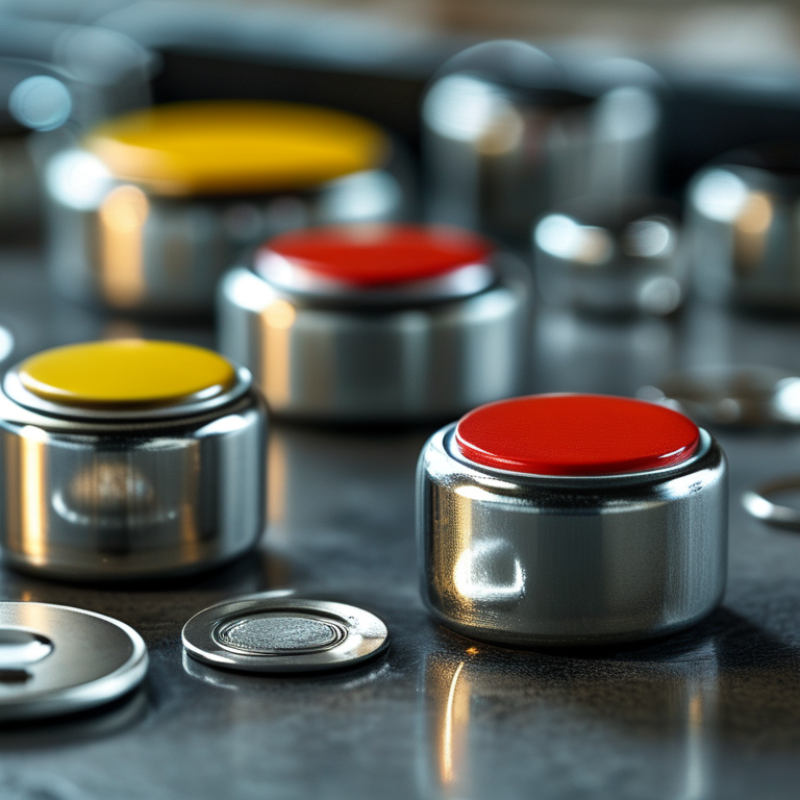
Button cell batteries are compact power sources for watches, sensors, medical devices, calculators, and memory functions. They are small. Their tolerances are not.
Common chemistries include alkaline, silver oxide, lithium, and zinc-air. Each chemistry offers different voltage, capacity, discharge behavior, and storage life. Lithium cells often support higher energy density and wider temperature ranges. Silver oxide cells can provide stable voltage during discharge. Zinc-air cells depend on air access, so their performance changes after activation. Cell diameter, height, terminal shape, and polarity must match the device design exactly. A slight size error can prevent reliable contact.
Engineers should also check pulse current, internal resistance, leakage risk, operating temperature, and shelf life. A device that sleeps most of the time may still need short power bursts. Datasheets help, but sample testing remains essential. Compare several production lots, not only one sample. Test cells inside the final device, under real loads and storage conditions. Packaging matters too. Insulation, tray design, and moisture control can reduce short circuits and handling damage. I have found that sourcing teams sometimes focus too heavily on capacity. That choice can miss voltage stability or contact reliability. The specification may look complete, yet one untested detail can create field failures. Fresh test results should guide the final battery selection.
Why Choose Button Cell Battery for Global Sourcing? - Button Cell Battery Basics and Key Design Features
| Category | Battery Type / Design Feature | Typical Electrical Data | Common Size Examples | Key Advantages | Important Design or Sourcing Considerations |
|---|---|---|---|---|---|
| Basic Definition | Button cell / coin cell | A small, compact primary or rechargeable cell with a round profile and low height. | The first two digits in many IEC-style designations indicate approximate diameter in millimetres; the remaining digits commonly indicate height in tenths of a millimetre. | Efficient use of space, low weight, simple integration, and suitability for high-volume electronic products. | Confirm exact dimensions, terminal orientation, capacity, discharge-current requirements, and approved chemistry before mass production. |
| Chemistry | Lithium manganese dioxide | Nominal voltage: approximately 3.0 V. Generally non-rechargeable. | CR2016, CR2025, and CR2032 are widely used lithium coin-cell formats. | High energy density, low self-discharge, long shelf life, and relatively stable voltage during discharge. | Lithium cells require appropriate transport, packaging, labeling, and safety documentation. Do not substitute a rechargeable cell without redesigning the charging circuit. |
| Chemistry | Alkaline manganese | Nominal voltage: approximately 1.5 V. Typically non-rechargeable. | LR44, LR41, and LR1130 are common alkaline button-cell formats. | Generally cost-effective and widely available for low-drain consumer applications. | Capacity and voltage performance can be affected by load, temperature, storage time, and leakage requirements. Verify compatibility with the device circuit. |
| Chemistry | Silver oxide | Nominal voltage: approximately 1.55 V. Typically non-rechargeable. | SR44, SR41, and SR626SW are common silver-oxide formats. | Stable discharge voltage and good energy performance in compact precision devices. | Silver-oxide cells can have a higher unit cost than alkaline equivalents. Confirm the required discharge profile and dimensional code rather than relying only on an alkaline cross-reference. |
| Chemistry | Zinc-air | Operating voltage is commonly around 1.4 V after activation. Usually non-rechargeable. | PR-series cells are commonly associated with hearing-aid applications. | High energy density for its size because oxygen from the air acts as a reactant. | The sealing tab must remain intact during storage. After activation, service life is influenced by air access, humidity, temperature, and current demand. |
| Rechargeable Option | Rechargeable lithium-ion, nickel-metal hydride, or other secondary button cells | Voltage varies by chemistry; rechargeable lithium-ion coin cells are commonly around 3.6–3.7 V nominal, while nickel-metal hydride cells are commonly around 1.2 V nominal. | Exact designation and dimensions vary by manufacturer and standard. | Supports repeated use and can reduce battery replacement frequency in suitable products. | The product needs a qualified charging system, protection design where applicable, thermal controls, and safety validation. Rechargeable and primary cells are not automatically interchangeable. |
| Mechanical Design | Positive and negative terminals | The broad flat surface is commonly the positive terminal, while the opposite surface is commonly the negative terminal; polarity must be verified from the cell marking and datasheet. | Flat cells, cells with solder tabs, and cells with connector assemblies are available in different constructions. | Flexible installation options for holders, direct-contact designs, soldering, and wire connections. | Specify tab material, tab position, wire length, connector type, insulation, and welding or soldering limitations when a custom assembly is required. |
| Mechanical Design | Sealing and casing | A metal can and seal help contain the electrolyte and protect the internal electrochemical system. | Dimensions and sealing construction vary by chemistry, size, and cell design. | Compact sealed construction supports portable and embedded electronics. | Avoid crushing, bending, puncturing, short-circuiting, or applying excessive heat. Confirm leakage resistance and storage conditions for the intended application. |
| Electrical Performance | Low-drain operation | Many button cells are optimized for low and intermittent current rather than continuous high-current loads. | Typical applications include watches, calculators, memory backup, sensors, remote controls, medical instruments, and small measurement devices. | Long operating periods can be achieved when the load is matched to the cell chemistry and capacity. | Evaluate continuous current, pulse current, cut-off voltage, temperature range, and internal resistance using the supplier's discharge curves. |
| Global Sourcing | Standards and interchangeability | IEC 60086 is a key international reference series for primary battery terminology, performance, dimensions, and testing; applicable parts should be checked for the selected chemistry. | A shared designation does not guarantee identical capacity, pulse performance, leakage resistance, or shelf life. | Using standardized size and chemistry codes simplifies supplier comparison and multi-region procurement. | Request dimensional drawings, datasheets, safety documents, production samples, and lot-level test results before approving an alternative source. |
| Global Sourcing | Quality control | Important checks include open-circuit voltage, load voltage, capacity, dimensions, weight, leakage, polarity, appearance, and date or lot coding. | Inspection criteria should be defined for incoming goods and agreed before production. | Clear acceptance criteria reduce the risk of inconsistent performance across different production lots. | Use sample approval, first-article inspection, periodic testing, traceability records, and documented change-control procedures. |
| Global Sourcing | Shipping and compliance | Transport requirements depend on chemistry, cell configuration, state of charge, packaging, destination, and mode of transport. | Lithium cells may require transport testing and documentation under applicable international and local rules. | Early compliance planning helps prevent customs delays, rejected shipments, and repackaging costs. | Confirm applicable UN, IATA, IMDG, ADR, customs, recycling, labeling, and extended producer responsibility requirements for each target market. |
| Product Integration | Holder and contact design | Contact resistance, retention force, polarity protection, and vibration resistance affect the electrical reliability of the assembled product. | Options include removable holders, spring contacts, welded tabs, and pre-wired battery packs. | A properly matched holder can simplify field replacement and reduce assembly errors. | Check contact plating, insertion force, clearances, vibration testing, accidental reverse insertion, and compatibility with the selected cell diameter and height. |
| Selection Principle | Application-to-chemistry matching | The best choice depends on voltage, current profile, required service life, operating temperature, storage duration, rechargeability, and safety requirements. | There is no universal replacement for every button-cell format. | Technical matching can improve reliability, total cost of ownership, and supply continuity. | Approve alternatives only after comparing electrical curves, mechanical fit, safety data, regulatory status, availability, lead time, and total landed cost. |
Note: Electrical values and size references are typical nominal values. Actual performance varies by cell design, manufacturer specification, load profile, temperature, storage conditions, and applicable standards.