
Top Steel Pipe Making Machine Suppliers Worldwide?

Choosing among the top Steel Pipe Making Machine suppliers worldwide is not a simple ranking exercise. A mill producing small-diameter precision tubes needs different equipment from one making large structural pipe. The right supplier must match your product range, output target, plant layout, and maintenance capacity. A polished brochure helps, but it cannot prove how a machine performs on your steel, shift after shift.

Taiichi Ohno, a pioneer of the Toyota Production System, is widely credited with saying, “Where there is no standard, there can be no kaizen.” His principle offers a useful lens for evaluating machinery: compare suppliers against clear, measurable requirements. Check forming and welding processes, pipe diameter and wall-thickness ranges, line speed, changeover time, and documented quality controls. Ask to see a comparable installation, not merely a demonstration running ideal material. Small details matter. A slow coil change or hard-to-source bearing can disrupt production long after commissioning.

This guide examines supplier capabilities, equipment configurations, technical support, and the practical questions buyers should ask before requesting a quotation. It also considers service coverage and spare-parts access, because a machine’s value depends partly on what happens after delivery. No single supplier is best for every factory. That is easy to say, harder to assess. Specifications can look complete while leaving out operator training, realistic output assumptions, or the cost of future upgrades. Compare evidence carefully, and treat unanswered questions as part of the decision.
Top Steel Pipe Making Machine Suppliers Worldwide?

Overview of Steel Pipe Making Machines

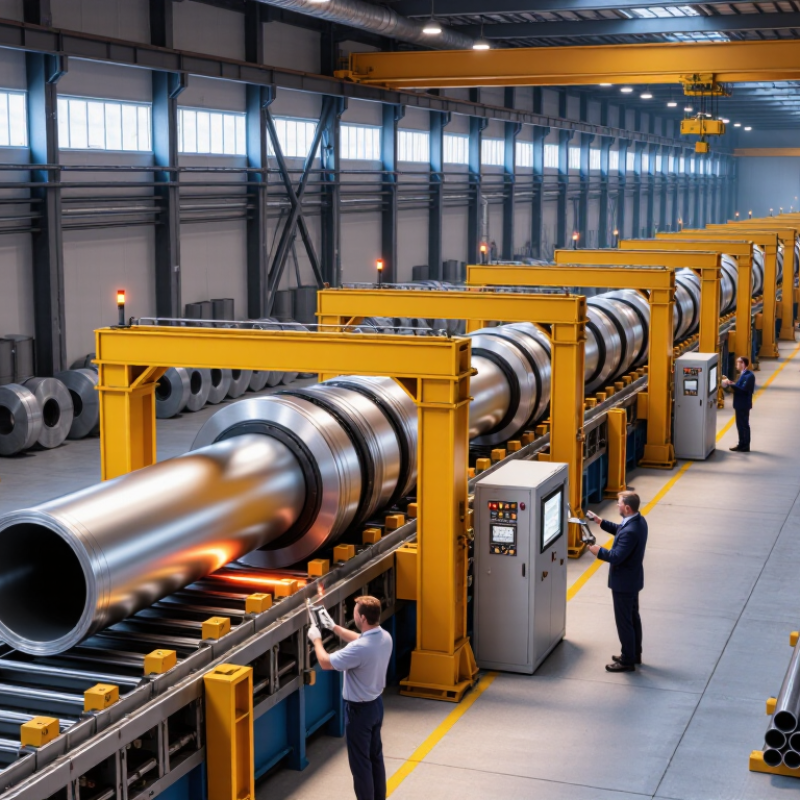
Steel pipe making machines turn flat steel coil into round, usable products through a sequence of controlled operations. A typical electric-resistance-welded line uncoils and levels the strip, forms it into a tube, welds the seam, then sizes and cuts it. The equipment may include forming stands, a high-frequency welding unit, cooling systems, sizing rolls, and an automatic cutoff saw. Each stage affects the final pipe’s dimensions and surface quality. Small adjustments matter.

Line selection depends on pipe diameter, wall thickness, steel grade, and required output. The World Steel Association reported 1,892.2 million tonnes of crude steel production worldwide in 2023 in its World Steel in Figures 2024 report. This broad supply context does not measure pipe-machine demand, but it shows the scale of the material industry serving downstream manufacturers. Buyers should also review weld inspection options, changeover time, energy use, and the availability of technical support. A fast line is not automatically a better one; actual performance can differ from brochure figures.

Tips: Ask suppliers for a sample production run using your target steel and dimensions. Check cut-end quality, weld consistency, and changeover steps in person. Record the line speed and reject rate. One detail is easy to miss: operators still need clear access for routine adjustments.

Main Machine Types and Production Processes

Steel pipe lines differ by forming method, and the machine choice shapes the finished tube. ERW lines begin with steel coils. A decoiler feeds strip through a leveling unit and forming rolls, which gradually turn it into a round shape. A high-frequency welder joins the edges, then sizing rolls set the diameter. The line usually includes a flying cut-off saw. Watch the weld area closely. Heat and pressure need steady control.

Spiral pipe machines form wide steel strip around a cylindrical mandrel. The strip edges meet at an angle, then a submerged arc welding system joins the seam. This process can produce large diameters, but floor space and handling capacity matter. Seamless pipe equipment follows another route: billets are heated, pierced, and rolled into hollow shells. Further elongation and sizing control wall thickness and final dimensions. It is a demanding process.

A supplier’s machine list is only part of the assessment. Ask how line speed changes with pipe diameter, wall thickness, and steel grade. Check whether the control system records key settings and whether operators can access maintenance points safely. Small details matter. A layout that looks efficient on a drawing may feel cramped beside a hot furnace or a coil-loading area. That deserves a closer review.

Steel Pipe Manufacturing: Typical Mill Diameter Ranges

Representative outside-diameter ranges for common pipe-making processes. Actual capabilities vary by mill configuration, material, and product specification; these are indicative ranges, not universal limits.

How to Evaluate Suppliers in the Global Market

When evaluating steel pipe making machine suppliers worldwide, compare documented capability, not polished brochures. Ask which pipe diameters, wall thicknesses, and steel grades a proposed line can handle. Request a sample production plan with expected output, changeover time, and power requirements. Specific answers matter.

Check how the supplier verifies quality. Request inspection records, commissioning procedures, and references from comparable installations. Ask who handles operator training and which spare parts are stocked. For overseas projects, clarify packing, shipping milestones, installation support, and response times across time zones. A low quotation can hide gaps.

Tips: Share your product specifications before requesting prices. Compare quotations line by line. Ask for a live machine demonstration, if practical, and confirm what the test includes. Keep the answers in writing.

Do not judge support by a promise alone. Ask a reference customer about downtime, troubleshooting, and parts delivery. Review warranty coverage and service exclusions in plain language. If a supplier cannot explain a technical limit clearly, pause and ask again. I would still leave room for uncertainty: a video demonstration cannot prove long-term reliability, and even a detailed schedule may shift during commissioning.

Notable Steel Pipe Making Machine Suppliers Worldwide

Notable steel pipe making machine suppliers worldwide differ in the pipe sizes, materials, and production volumes they support. Some focus on high-speed electric resistance welding lines, while others build equipment for spiral or longitudinal pipe production. Their systems may include forming stands, welding units, sizing rolls, and cut-off equipment. Details matter. A machine suited to thin-wall tubes may not handle heavy sections reliably.

Experienced suppliers can explain how a line performs with the buyer’s actual steel grade and target dimensions. Ask for production data under comparable conditions, not just a maximum speed on a brochure. A useful factory visit may reveal the sound of the weld station, the space needed for coil handling, and how quickly operators can change roll sets. These checks are practical, but they are sometimes skipped when schedules are tight.

After-sales support also separates capable suppliers from equipment sellers with limited service. Confirm who supervises installation, trains operators, and provides replacement parts. Response times and technical documentation matter when a line stops unexpectedly. Request clear drawings, maintenance intervals, and commissioning criteria before purchase. Even a well-built machine can disappoint if local technicians lack training. Supplier comparisons are rarely perfect; specifications may be presented differently, so buyers should clarify assumptions and record them before evaluating proposals.

Top Steel Pipe Making Machine Suppliers Worldwide? - Notable Steel Pipe Making Machine Suppliers Worldwide

Non-branded overview of common supplier specializations and steel pipe production technologies. This is not a company ranking; machine configurations and capabilities vary by supplier and project.

Supplier specialization Typical equipment Production method Typical applications Key evaluation points
ERW pipe mill suppliers Coil handling, forming stands, high-frequency welding, sizing, cutting, and inspection equipment Flat strip is continuously formed into a tube; the edges are joined by electric resistance welding, commonly using high-frequency current. Structural tubes, line pipe, and other welded pipe products, subject to the mill design and applicable product standards Confirm coil-width and thickness range, weld monitoring, dimensional tolerances, changeover requirements, and inspection provisions.
Spiral welded pipe mill suppliers Uncoiler, strip-edge preparation, spiral forming equipment, submerged arc welding systems, and pipe finishing equipment A steel strip is formed helically into a pipe; the seam is commonly welded using the submerged arc welding process. Large-diameter water, piling, and transmission pipe applications, depending on product specification Check the specified diameter and wall-thickness envelope, forming accuracy, weld procedures, and available non-destructive testing.
Longitudinal submerged arc welded (LSAW) mill suppliers Plate edge milling, press forming, tack welding, internal and external submerged arc welding, and expansion equipment Steel plate is formed into a cylinder with a longitudinal seam, which is welded using submerged arc welding. Press-forming routes include JCOE and UOE configurations. Large-diameter, heavy-wall pipe used in energy, infrastructure, and industrial projects Review plate-size limits, forming and expansion control, weld qualification, dimensional inspection, and hydrostatic testing arrangements.
Seamless pipe mill suppliers Billet heating furnace, piercing mill, elongation and sizing mills, cooling systems, and finishing equipment A heated solid billet is pierced and rolled into a hollow product without a welded seam; production routes vary by mill design. Mechanical, pressure-service, and energy-sector pipe, depending on material grade and production specification Assess billet dimensions and grades, rolling route, heat-treatment capability, dimensional control, and testing requirements.
Pipe finishing and testing line suppliers Straightening, end facing, beveling, hydrostatic testing, non-destructive examination, marking, and handling systems Downstream operations prepare and inspect pipe after forming or welding; the exact sequence depends on the product standard and customer specification. Finishing and quality-control stages for welded and seamless pipe production Verify test pressure and size range, inspection methods, data recording, handling capacity, and integration with the mill line.

Industry Trends and Key Buyer Considerations

Steel pipe production is shifting toward flexible lines that handle more sizes with fewer lengthy changeovers. Buyers are also asking for digital monitoring, lower energy use, and consistent weld quality. Useful features, but performance depends on the material, wall thickness, and target output. A quoted speed means little if it applies to a different specification. Ask suppliers to run representative samples and record dimensions, weld results, and changeover time. Small details count.

Compare the complete line, not just the forming machine. Check how forming, welding, sizing, cutting, and material handling work together. Confirm tooling availability, spare-part lead times, operator training, and commissioning support in your region. Request references from plants making similar pipe, then ask what needed adjustment after installation. Also review power requirements and floor-space drawings before committing. A lower purchase price can hide setup costs or slow service response. And specifications can look precise while leaving changeover assumptions unclear. Put those assumptions in writing, even if it feels overly cautious.

Go to Top