
What Are the Top Silicone Adhesive Types for 2026? This question matters as manufacturers demand stronger, cleaner, and more durable bonding solutions. Silicone Adhesive technologies now support electronics, medical devices, automotive assemblies, construction panels, and flexible consumer products. Each application faces different stresses. Heat, moisture, vibration, chemicals, and surface movement can change performance quickly.
Dr. Edward M. Petrie, a respected adhesives specialist, offers a useful principle: “The best adhesive is the one that meets the requirements of the application.” That idea remains highly relevant for 2026. A fast-curing adhesive may suit an automated production line. A low-modulus grade may perform better around a vibrating engine cover. Optical electronics may require a transparent, non-yellowing formulation. Medical assemblies demand careful attention to purity, biocompatibility, and curing conditions.
There is no universal winner. That assumption can fail.
This guide examines the leading Silicone Adhesive types expected to attract attention in 2026. It compares one-part and two-part systems, moisture-cure and heat-cure technologies, room-temperature vulcanizing grades, pressure-sensitive options, and electrically functional formulations. The discussion will consider adhesion strength, working time, cure depth, flexibility, and aging resistance. It will also highlight practical details, such as surface cleaning, bead geometry, fixture time, and humidity control.
Some products appear impressive on a datasheet but disappoint during real assembly. Small gaps, oily surfaces, or uneven curing can expose those weaknesses. Reliable selection therefore requires technical data, supplier testing, and application-specific trials. Performance should be measured, not assumed.
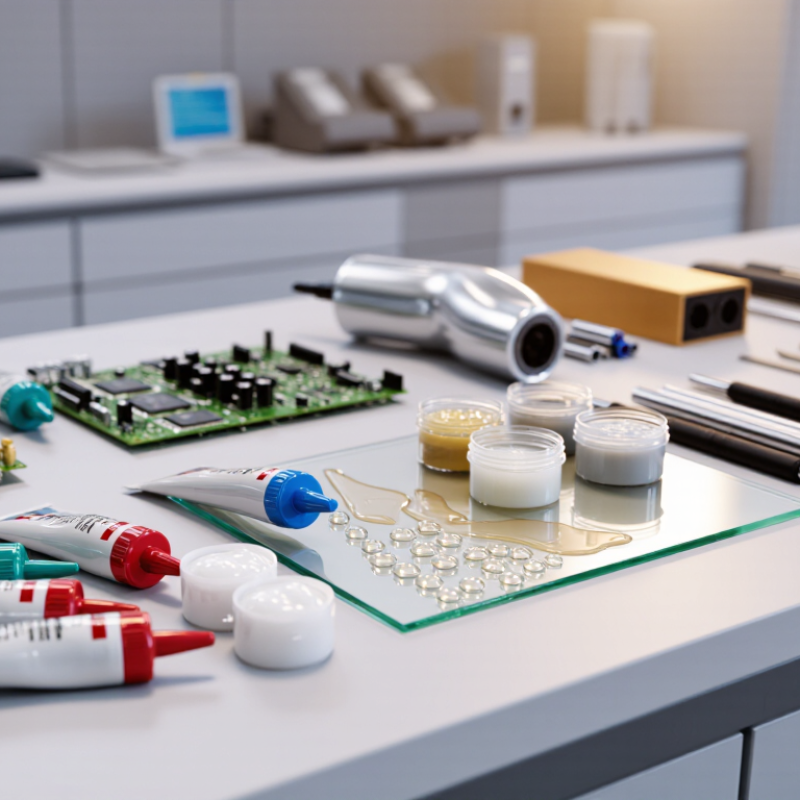
Silicone adhesive is an elastomer-based bonding material that cures into a flexible, rubber-like solid. It usually combines a silicone polymer, crosslinking agent, filler, and curing catalyst. Moisture-cure formulas react with air humidity, while two-part systems cure after their components are mixed. The chemistry matters because it controls adhesion, cure speed, odor, and by-products.
Its main performance feature is flexibility across changing temperatures. A cured silicone layer can absorb vibration, tolerate movement, and seal small surface gaps. Many grades remain stable under sunlight, moisture, and repeated heating cycles. However, “high temperature” does not mean unlimited heat resistance. Engineers should check continuous and peak temperature data separately.
Surface preparation still decides many bonding results. Dust, oil, and release agents can weaken adhesion, even when the adhesive seems suitable. Glass, coated metals, plastics, and painted surfaces may require different cleaning methods or primers. Neutral-cure types often suit sensitive metals and electronics, while acetoxy-cure types can offer fast skin formation on compatible surfaces. Conductive and thermally conductive grades serve more specialized designs. Testing should include peel strength, shear strength, aging, and cure depth. A lab result is not a field result. In real production, uneven bead size and changing humidity can create unexpected failures. I would also question any datasheet that gives one impressive value without test conditions.
What Are the Top Silicone Adhesive Types for 2026?
Silicone adhesives remain important where flexibility, weather resistance, and temperature stability matter. Grand View Research estimated the global silicone adhesives market at about USD 3.6 billion in 2023. Its forecast indicates continued growth through 2030, supported by electronics, transportation, construction, and medical equipment. Market estimates vary, though. That difference deserves attention.
One-part silicone adhesives cure when exposed to moisture in the air. They arrive ready to use, which reduces mixing errors and simplifies small-batch assembly. I have found them practical for sealing cable entries, glass panels, and outdoor housings. Cure speed depends heavily on humidity, joint thickness, and ventilation. Deep sections may remain soft for longer than expected. That is the weakness.
Two-part silicone adhesives mix a base and catalyst before application. They cure more consistently in thick joints and controlled production lines. A 2024 MarketsandMarkets report projected steady growth for silicone adhesives, with electronics and automotive applications among key demand areas. Two-part systems can improve throughput, but equipment, metering accuracy, and waste become real concerns. A slight mixing imbalance may leave uncured material inside the joint. Test it.
For 2026, one-part systems suit repair work, general sealing, and simpler production. Two-part systems fit thicker bonds, automated dispensing, and tighter process control. Engineers should compare cure time, modulus, adhesion, temperature cycling, and moisture exposure. Price alone gives an incomplete answer. Even experienced teams sometimes overlook surface preparation. Clean, dry substrates still decide many failures.
How One-Part and Two-Part Silicone Adhesives Differ
The chart compares representative curing-time ranges for common industrial silicone adhesive systems. One-part silicones cure by reacting with atmospheric moisture, so cure speed depends strongly on humidity, temperature, and bond thickness. Two-part silicones cure after the resin and catalyst are mixed, providing more predictable internal curing for thicker sections. Actual performance varies by formulation and application conditions.
High-temperature silicone adhesives are gaining importance as equipment becomes smaller, hotter, and more heavily automated. According to Grand View Research, the global silicone adhesives market was valued at approximately USD 3.6 billion in 2023, with continued growth expected through 2030. RTV silicone suits field repairs and uneven joints. Heat-cure grades fit controlled production lines.
Their strongest advantage appears during repeated thermal cycling. Oven doors, industrial heaters, engine sensors, lighting systems, and HVAC assemblies often face heat, vibration, and moisture together. A suitable adhesive can remain flexible near 200°C or higher, depending on its formulation. It also helps seal small gaps around metal, glass, and coated surfaces. In practice, surface preparation matters more than many purchasing teams expect. Oil, dust, and release agents can quietly weaken the bond.
MarketsandMarkets identifies electronics, transportation, and industrial applications as important growth areas for silicone adhesives. These sectors increasingly need materials that tolerate heat without becoming brittle. However, “high temperature” is not a single performance class. Continuous exposure differs from short thermal spikes. Cure speed can also conflict with deep-section reliability. That is an easy detail to overlook. Engineers should test bonded samples through realistic heating, cooling, humidity, and vibration cycles. A 2026 material choice may look efficient on paper, yet fail after imperfect cleaning or uneven joint design. Small trials remain worthwhile.
| Silicone Adhesive Type | Typical Cure System | Typical Continuous Service Temperature | Key Performance Characteristics | Best-Fit Applications | Important Selection Considerations |
|---|---|---|---|---|---|
| One-Part RTV Silicone | Moisture-cure; commonly acetoxy or neutral cure | Approximately −50°C to 200°C | Ready to use, flexible, weather-resistant, and capable of filling irregular gaps | Gasketing, appliance assembly, HVAC sealing, electrical enclosures, and general maintenance | Acetoxy grades may release acetic acid during cure and can be unsuitable for some metals, electronics, and sensitive substrates |
| Neutral-Cure RTV Silicone | Moisture-cure; oxime, alkoxy, or related neutral systems | Approximately −50°C to 200°C | Low-corrosion curing, strong weatherability, good adhesion to glass, metals, plastics, and coated surfaces | Automotive sealing, electronic housings, facade joints, glazing, and mixed-substrate assemblies | Cure speed depends on humidity, bond-line thickness, and ventilation; adhesion testing is recommended for low-surface-energy plastics |
| Two-Part RTV Silicone | Two-component addition or condensation cure | Approximately −60°C to 250°C | Fast, more uniform curing in thick sections, low shrinkage, and consistent production performance | High-volume assembly, potting, thermal management, sensors, lighting, and complex molded or encapsulated parts | Requires accurate metering and mixing; working time and cure profile must match the production process |
| High-Temperature Silicone Adhesive | One-part or two-part RTV, formulated with heat-stable additives and fillers | Approximately −50°C to 300°C | Maintains flexibility and sealing performance during repeated heating and cooling cycles | Ovens, exhaust components, industrial furnaces, heat shields, engine compartments, and high-temperature gaskets | Short-term peak temperature may exceed the continuous rating; verify exposure duration, joint design, and thermal cycling requirements |
| Thermally Conductive Silicone Adhesive | Usually two-part addition-cure or one-part moisture-cure | Approximately −50°C to 200°C | Combines electrical insulation with heat transfer and compliant bonding | LED modules, power electronics, battery components, heat sinks, sensors, and control systems | Thermal conductivity, bond-line thickness, dielectric strength, cure shrinkage, and surface flatness all affect final performance |
| Electrically Insulating Silicone Adhesive | One-part or two-part RTV | Approximately −50°C to 200°C | Dielectric insulation, vibration resistance, moisture protection, and long-term flexibility | Electrical connectors, wire harnesses, circuit-board protection, transformers, and sensor assemblies | Check dielectric strength, volume resistivity, ionic purity, outgassing, and compatibility with conformal coatings |
| Optically Clear Silicone Adhesive | Typically addition-cure or low-yellowing moisture-cure | Approximately −50°C to 150°C | High light transmission, flexibility, UV resistance, and low visual distortion | Display bonding, LED optics, transparent covers, photovoltaic components, and lighting systems | Optical clarity, refractive index, yellowing resistance, bubble control, and cure shrinkage are critical |
| Silicone Pressure-Sensitive Adhesive | Pre-cured coating; bonds through pressure rather than a chemical cure | Approximately −50°C to 260°C | Immediate tack, clean removability in selected grades, and strong performance across wide temperature ranges | High-temperature masking tapes, splicing materials, labels, medical products, and electrical insulation tapes | Performance depends on dwell time, pressure, substrate cleanliness, peel strength, and the selected backing material |
| Silicone-Modified Hybrid Adhesive | Moisture-cure hybrid chemistry combining silicone flexibility with enhanced adhesion | Approximately −40°C to 150°C | Good weatherability, paintability in selected formulations, low odor, and strong adhesion to construction materials | Construction joints, transportation interiors, architectural panels, and mixed-material assemblies | Maximum temperature is generally lower than specialized high-temperature RTV grades; confirm paint and sealant compatibility |
| Temperature ranges are typical industry-use ranges rather than universal specifications. Actual performance depends on formulation, cure conditions, joint geometry, substrate preparation, chemical exposure, thermal cycling, and the adhesive manufacturer’s technical data sheet. | |||||
In 2026, silicone adhesive selection depends on joint demands, not marketing labels. Structural silicone adhesives suit load-bearing bonds between glass, metal, ceramics, and coated surfaces. They distribute stress across a wide area. Engineers should verify tensile strength, cure depth, temperature cycling, and surface preparation. A clean bond line matters more than a generous bead.
Flexible silicone adhesives work better where parts move, vibrate, or expand at different rates. They are useful for seals, electronics housings, vehicle components, and outdoor assemblies. Their elasticity reduces stress around corners and thin substrates. However, flexibility does not mean unlimited strength. I would inspect peel resistance and recovery after repeated movement. A flexible bond can still fail when the joint design traps moisture.
Pressure-sensitive silicone adhesives provide immediate tack with little or no curing equipment. They fit tapes, labels, protective films, and light-duty mounting tasks. Choose them when fast handling matters more than maximum structural strength. Check adhesion after heat exposure, dust contact, and repeated removal. Small contamination can weaken the bond surprisingly fast. No option is perfect. Some early evaluations also overlook release liners, storage conditions, and surface energy. A short trial using real substrates, actual temperatures, and measured peel or shear loads is usually more reliable than a catalog value.
What Are the Top Silicone Adhesive Types for 2026?
Choosing the right silicone adhesive starts with the application, not the product label. Acetoxy-cure silicone suits glass and ceramic, but its acidic by-products may attack copper or sensitive metals. Neutral-cure silicone is safer for electronics, coated metals, and masonry. It usually cures more slowly, though.
For flexible joints, RTV silicone handles vibration, weather changes, and uneven surfaces. One-part formulas simplify production, while two-part systems offer faster, more controlled curing. Thermally conductive silicone adhesives fit heat-generating components, but they may provide less flexibility. Clear silicone helps with visible seams, yet optical appearance can change after aging.
Check the substrate, joint width, service temperature, movement, and exposure to water or chemicals. A rooftop seal needs different resistance than a small indoor enclosure. Test adhesion on the actual materials, including coatings and plastics. Measure cure time, peel strength, and shear performance under realistic conditions. Do not rely on a small fingertip test.
Allow for surface preparation. Dust, oil, and release agents can quietly ruin a strong formulation. I would question any choice based only on high temperature claims. In real assemblies, poor contact often matters more than the advertised limit. Samples should face heat, humidity, vibration, and repeated movement before approval. Some failures appear late. That is the uncomfortable part.