
Choosing a Portable Light Strip for international use requires more than comparing brightness and price. A strip that looks impressive online may become dim inside a tent, overheat behind a television, or lose its adhesive in humid weather. Buyers must examine length, LED density, color temperature, battery capacity, charging method, water resistance, controller quality, and replacement availability.
Lighting engineer James R. Benya has emphasized, “Good lighting should support the task, not compete with it.” That principle matters here. A warm strip can create a comfortable hotel atmosphere, while a brighter neutral-white model may suit a workbench or emergency kit. The right decision depends on real conditions.
Check the details closely.
Global purchasing adds practical risks. USB-C input does not always mean fast charging. A rechargeable battery may perform differently in cold Canadian conditions or hot coastal storage. Adhesive backing can fail on dusty walls. App controls may also be unreliable when regional software support is limited. These are easy details to overlook.
This guide presents ten buying tips for evaluating a Portable Light Strip with greater confidence. It considers everyday use, transport, safety, durability, packaging, and supplier communication. Some recommendations may seem obvious. They are still frequently missed. Product claims deserve verification through test videos, sample orders, warranty terms, and clear technical sheets.
No product is perfect.
A careful buyer should question exaggerated lumen figures and vague battery claims. Small compromises may be acceptable, but hidden limitations should never surprise you after delivery.
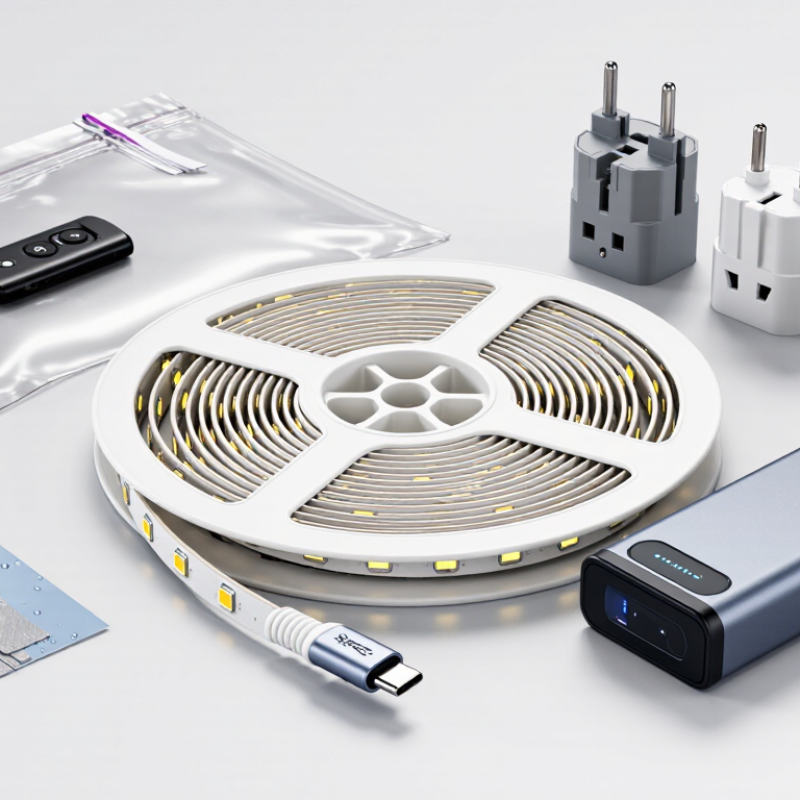
Before choosing a portable light strip, define the job it must perform. A reading corner needs steady, low-glare light, while a market display may need stronger brightness. For photography, check color rendering, not only advertised lumens. A strip rated around CRI 80 to 100 shows product colors more honestly. I once judged brightness by appearance alone. That was a mistake.
Measure the installation area twice. Record the usable length, corners, and distance to the power source. A two-meter strip may fail when the cable route adds another 40 centimeters. Avoid cutting unless the product marks safe cut points.
For temporary use, USB-powered models are often simpler for international buyers. Confirm input voltage, connector type, and power-bank compatibility before ordering. Small details matter.
Portability depends on more than weight. Look for flexible housing, a compact reel, protected connectors, and a controller that will not snag in a bag. If outdoor use is planned, match the IP rating to rain and dust exposure. Do not assume “water resistant” means safe for every condition. Test one sample during setup. Check heat after thirty minutes, especially near fabric or plastic. My packing plan ignored the controller once, making the strip difficult to deploy. A short checklist would have prevented that problem.
When buying a portable light strip, inspect its power source before its color effects. A USB-powered model suits desks, tents, and temporary displays with a nearby power bank. Rechargeable units are cleaner for moving around, but runtime depends on brightness, temperature, and battery age. Disposable batteries may help in emergencies, yet replacement costs and waste increase over time. Check the input voltage and connector type carefully. A bright strip can drain a small power bank before an evening ends. Measure twice.
Ask how long the strip runs at the brightness you actually use, not the advertised maximum. In practical testing, medium brightness often gives a better balance than full output. For a six-hour outdoor event, choose a battery rated beyond six hours, preferably with reserve capacity. Cold weather can reduce battery performance, while heat can shorten battery life. Look for clear capacity information in watt-hours or milliamp-hours. Check whether the stated runtime includes animation modes. Numbers are not always comparable. This is where many buyers misjudge.
Charging options also affect daily reliability. USB-C charging is convenient when phones, laptops, or vehicle adapters are already available. For international use, confirm the charger supports local voltage and plug requirements. A built-in indicator helps prevent forgotten charging, while pass-through charging supports longer tasks. However, pass-through use may create extra heat and reduce battery health. Use a suitable charger and avoid charging damaged battery packs. I once underestimated cable length and left the power bank hanging from a shelf. The strip worked, but the setup was awkward. Plan the cable route, charging time, and socket access before purchase.
When buying a portable light strip, measure brightness in lumens, not vague “high power” claims. A compact strip may look bright in a dark room but weak beside a window. The U.S. Department of Energy’s Solid-State Lighting research highlights efficacy and color quality as separate performance measures. Check lumens per metre, power consumption, and dimming stability together. For reading areas, neutral white near 4000K often feels clearer; warmer light near 2700–3000K suits bedrooms. Test the strip at its lowest setting, too. Flicker can become uncomfortable during filming or prolonged work.
Color quality deserves more than a high CRI label. The International Commission on Illumination recommends evaluating color fidelity with modern metrics, because CRI may not reveal every saturated-color error. Choose CRI 90 or higher for artwork, food displays, or product photography. For general decoration, CRI 80 may be adequate. The compromise is real. Some high-CRI strips sacrifice efficiency or maximum brightness. I have found that printed color charts can mislead under colored light, so inspect familiar objects before purchasing.
Controls should remain usable without an internet connection. Look for physical buttons, reliable remote control, preset scenes, and smooth dimming below 10%. Bluetooth SIG’s 2023 market update forecast over 5.4 billion Bluetooth device shipments annually by 2028, showing why wireless control is becoming common. Still, app compatibility varies by region and phone system. Verify Wi-Fi bands, Bluetooth range, and data permissions. A light that needs three applications is technically clever, but practically frustrating.
Portable light strips look simple, but buying for global use requires careful inspection. I once chose a strip mainly for brightness. That shortcut caused trouble. The adhesive loosened in warm, humid weather, and the cable felt fragile during installation. Flexibility matters, especially around shelves, tent frames, vehicle interiors, or curved displays. Check the minimum bend radius and avoid sharp folding. A strip that bends smoothly is less likely to crack internally.
Tip: Examine the materials closely. Silicone usually handles heat and moisture better than thin plastic, while a protected copper circuit can improve durability. Press the connector gently. It should feel secure, not loose. For outdoor use, check the stated IP rating carefully. An IP65 product can resist water jets, but it is not designed for submersion. Dusty roads, coastal air, freezing nights, and strong sunlight may still shorten its life.
Tip: Treat safety as a buying requirement, not an extra feature. Confirm the operating voltage, charger compatibility, insulation, and battery protection system. Look for overcharge, short-circuit, and overheating safeguards. Local electrical requirements may differ, so verify the documentation for your destination market. Some listings provide vague safety claims. That should make you pause. I also prefer testable details, such as cable size, rated runtime, and temperature limits. No checklist is perfect, but specific information exposes weak products quickly.
Check flexibility, materials, weather resistance, and safety features before choosing a portable light strip.
How to read the chart: The first IP digit indicates protection against solid particles, while the second digit indicates protection against water. IP65 and higher are commonly considered more suitable for outdoor exposure, but the correct rating depends on the installation environment.
Buyers should also confirm the strip’s bending radius, choose durable silicone or similarly resistant materials, verify UV and temperature performance, and use a certified low-voltage power supply with overload and short-circuit protection. An IP rating does not replace electrical safety certification or correct installation.
When buying portable light strips internationally, certification checks should begin before price discussions. I have seen attractive samples fail because the supplier could not match the test report to the production batch. Ask for current certificates, laboratory details, product ratings, and the exact model number. Paper is not proof. Confirm whether the documents cover electrical safety, electromagnetic compatibility, battery transport, and the intended market. A visible batch code on the strip, controller, and packaging improves traceability.
Supplier reliability requires more than fast replies. Request a factory address, production photos, quality-control records, and a small paid sample. Test brightness, connector heat, adhesive strength, charging time, and runtime in realistic conditions. Ask how many units they inspect before shipment. A supplier avoiding technical questions deserves caution. I once underestimated response delays across time zones, and that mistake complicated a replacement order. Clear response windows should be written into the agreement.
Pricing should be compared by usable performance, not unit cost alone. Include packaging, spare parts, testing, shipping, duties, and expected defect rates. An unusually low quote may hide thinner wiring or weaker batteries. Ask for a detailed cost breakdown. After-sales support must include troubleshooting instructions, replacement parts, warranty terms, and a named contact. Request photos or videos for remote diagnosis. Ask how claims are recorded and resolved. That delay matters. A slightly higher price can be reasonable when documentation and support reduce operational risk. Still, do not accept vague promises. Get every important condition in writing.
| No. | Buying Dimension | What to Check | Practical Benchmark | Verification Method | Priority |
|---|---|---|---|---|---|
| 1 | Define the Intended Market | Confirm destination countries, voltage requirements, plug type, customs rules, language needs, and intended application before requesting quotations. | Use the destination market's applicable electrical, battery, radio, and packaging requirements rather than relying on one global standard. | Prepare a country-by-country compliance checklist and have the importer or customs broker review it before purchase. | High |
| 2 | Verify Electrical Safety Certifications | Check whether the complete product, power adapter, controller, and battery pack have the certifications required for the destination market. | Common requirements may include CE for applicable European market rules, UKCA for applicable UK rules, FCC for relevant U.S. electromagnetic compatibility requirements, and electrical safety testing such as IEC 60598-1 where applicable. | Request certificates, test reports, model numbers, test-lab details, and validity information. Confirm that the documents match the exact supplied configuration. | Critical |
| 3 | Check Battery and Transport Compliance | For rechargeable portable strips, verify cell chemistry, rated watt-hours, protection circuitry, charging method, and shipping documentation. | Lithium-ion products commonly require UN 38.3 testing for transport, suitable packaging, and battery safety documentation. Exact requirements depend on battery type and shipping route. | Obtain the UN 38.3 test summary, Safety Data Sheet when applicable, battery specification sheet, and transport classification from the supplier. | Critical |
| 4 | Compare Light Performance | Evaluate LED type, color temperature, color-rendering performance, brightness, dimming range, beam consistency, and heat management. | Request measured lumen output, color temperature tolerance, CRI data, operating temperature, and rated service life. Avoid comparing wattage alone. | Ask for a photometric report or independent sample test. Compare samples at the same distance, power level, and camera settings. | High |
| 5 | Assess Portability and Durability | Review strip length, flexibility, bend radius, adhesive or mounting method, connector strength, enclosure material, and ingress protection rating. | For outdoor or damp locations, require a clearly stated IP rating suitable for the application. An IP rating does not automatically confirm resistance to immersion, heat, or chemicals. | Inspect samples, request the IP test report where relevant, and perform repeated bending, mounting, connector, and splash checks. | High |
| 6 | Evaluate Runtime and Charging | Confirm battery capacity, brightness settings, charging time, charging connector, low-battery behavior, and whether the strip can operate while charging. | Runtime varies substantially with brightness, LED density, battery capacity, and control mode; require test results at low, medium, and maximum output. | Conduct a timed discharge test using the final production sample and record brightness level, ambient temperature, and shutdown time. | High |
| 7 | Measure Supplier Reliability | Review manufacturing capability, quality-control procedures, export experience, production capacity, lead times, and communication quality. | A dependable supplier should provide consistent specifications, traceable production records, clear payment terms, and realistic delivery commitments. | Use factory audits, trade references, business registration checks, sample orders, inspection records, and a written quality agreement. | Critical |
| 8 | Compare Total Landed Cost | Include product price, packaging, tooling, inspection, freight, insurance, duties, taxes, marketplace fees, and expected replacement costs. | For small shipments, international freight and customs charges can materially exceed the factory-price difference between two quotations. | Request quotations using the same Incoterm, quantity, specification, packaging, currency, and delivery destination. Calculate landed cost per sellable unit. | High |
| 9 | Set Quality and Inspection Controls | Define acceptable limits for brightness, color consistency, battery capacity, charging safety, dimensions, cosmetic defects, packaging, and accessories. | Use a written specification and agreed sampling plan. Inspection standards should be established before mass production, not after delivery. | Approve a golden sample, conduct pre-production and pre-shipment inspections, and retain batch or serial-number records. | Critical |
| 10 | Confirm Warranty and After-Sales Support | Clarify warranty duration, defective-unit procedure, spare parts, replacement controllers, firmware support, response time, and responsibility for return freight. | The warranty should state coverage exclusions, claim evidence, resolution time, repair or replacement terms, and the process for recurring defects. | Include service-level terms in the contract, test the support channel before ordering, and request a written returns and replacement policy. | Critical |
Note: Certification, labeling, battery, customs, and environmental requirements vary by product configuration and destination market. Always confirm the current requirements with the relevant authority, qualified testing laboratory, importer, or customs professional.