2026 Top Electric Three Wheeler Cargo for Global Buyers
Global buyers are looking beyond low prices when choosing an Electric Three Wheeler Cargo for urban delivery. They need dependable payload capacity, safe battery systems, practical range, and support after purchase. A vehicle may look strong in a showroom. The real test begins on narrow streets, uneven roads, steep ramps, and rainy loading areas.
Timur Gül, Chief Energy Technology Policy Officer at the International Energy Agency, has stated, “Electric two- and three-wheelers are the most electrified road transport segment globally.” This observation reflects a major market shift. Small electric cargo vehicles are already serving food distribution, parcel delivery, agricultural transport, and neighborhood logistics. However, adoption is not automatic. Buyers must examine battery chemistry, charging time, motor performance, braking quality, warranty coverage, and local service capability. A larger battery is not always better. It can increase weight, cost, and charging demand.
This guide reviews the 2026 Electric Three Wheeler Cargo market for international purchasers. It compares vehicle structure, rated payload, driving range, cabin protection, charging options, and operating efficiency. It also considers details that brochures often simplify, such as battery performance in heat, spare-parts availability, and real-world range under full load. Important gaps remain. Manufacturer figures may use ideal testing conditions. Some suppliers still provide limited maintenance data. Careful verification is essential. A reliable purchase should match the vehicle to its route, climate, cargo, and local regulations—not merely to its advertised specifications.
Electric Three-Wheeler Cargo Vehicles: Definition and Core Features
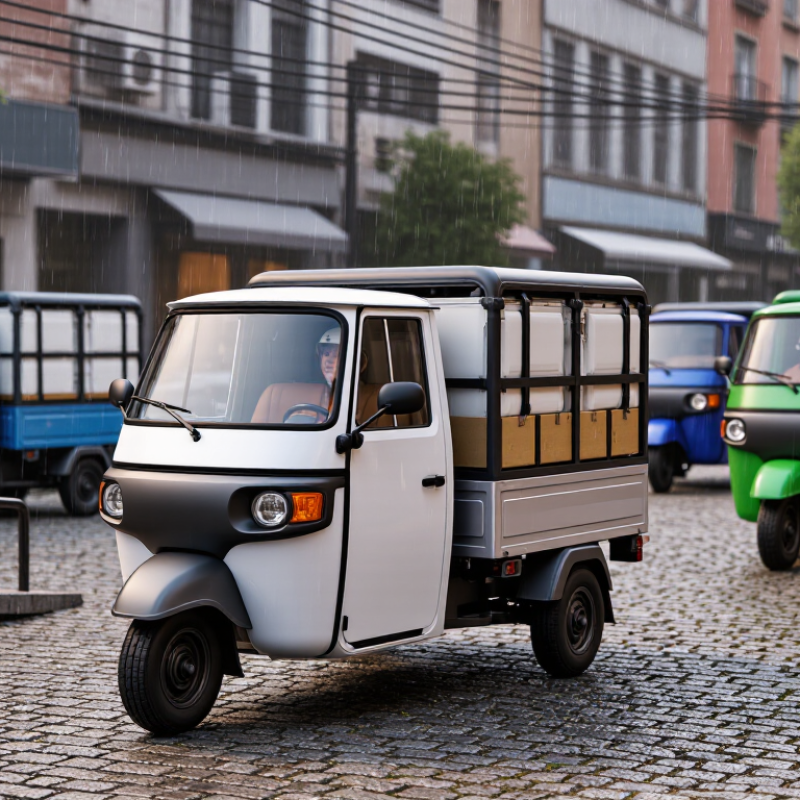
An electric three-wheeler cargo vehicle is a compact commercial vehicle powered by a battery and electric motor. It usually combines a front steering wheel with two rear wheels, a reinforced frame, and a rear cargo box. This layout supports deliveries on narrow streets, farm paths, and crowded urban routes.
Core features include payload capacity, battery size, motor output, braking performance, and charging access. A practical cargo model should carry its rated load without unstable handling. Buyers should inspect the floor strength, side-panel height, suspension, and turning radius. These details matter when transporting produce, tools, parcels, or water containers.
Battery range depends on payload, road surface, temperature, speed, and driving habits. A vehicle rated for 120 kilometers may travel less on hills with heavy cargo. Range claims need careful testing. Check charging time, battery protection, service access, and replacement procedures. Mechanical or hydraulic brakes can improve control, especially on slopes. Lights, mirrors, reflectors, seat belts, and weather protection also deserve close attention.
Specifications can look impressive.
They are not the whole story.
In real purchasing work, buyers should compare local road conditions, operating hours, available electricity, and legal requirements. A lower-cost vehicle may require stronger maintenance support. A larger battery may increase useful range, but it can also reduce cargo capacity and raise charging demands. The best choice is rarely the most powerful one; it is the model that performs reliably during ordinary daily work.
Key Types of Electric Cargo Three-Wheelers for Global Buyers
Electric cargo three-wheelers serve different jobs, and their body design matters as much as battery capacity. Box-body models protect parcels from rain, dust, and roadside contact. They suit urban delivery routes with frequent stops and narrow streets. Open flatbed models carry crates, tools, building materials, or farm produce. Their side rails can improve safety, but loading still requires careful weight distribution.
Tipper versions help move sand, soil, and recyclable materials. A hydraulic lifting system saves manual effort, though it adds weight and maintenance needs. Refrigerated cargo bodies support food and medical supply transport where stable temperatures matter. Buyers should check insulation quality, cooling power, and battery use during long stops. Small utility models work well for campuses, resorts, and local service teams. They usually offer easier parking and lower operating costs.
Real route testing is more useful than brochure figures. Measure payload, road slope, stop frequency, charging access, and daily distance. A vehicle rated for one load may perform differently on rough roads. That deserves attention. Battery chemistry, removable packs, braking performance, lighting, and weather protection also influence reliability. Confirm local approval rules, axle limits, dimensions, and charger compatibility before ordering. Some buyers focus too heavily on range and overlook driver comfort. Seat position, entry height, mirrors, and vibration affect productivity over a full working day. No single layout fits every market.
2026 Top Electric Three-Wheeler Cargo for Global Buyers
Key Types of Electric Cargo Three-Wheelers for Global Buyers
The chart compares typical rated payload capacity bands used in global electric cargo three-wheeler applications. Light-duty models are commonly used for urban parcel delivery, medium-duty models support retail and food distribution, while heavy-duty models are designed for agricultural, construction and longer-haul cargo operations. Actual capacity, range and performance vary according to battery size, road conditions and local regulations.
Battery, Motor, Load Capacity, and Range Specifications
2026 Top Electric Three Wheeler Cargo for Global Buyers
Battery, Motor, Load Capacity, and Range Specifications
Electric three-wheel cargo vehicles are becoming practical for urban delivery and small-farm transport. The battery deserves close inspection. A 60V, 100Ah battery stores about 6 kWh before energy losses. Lithium batteries usually reduce weight and support more charging cycles than lead-acid units. Buyers should request usable capacity, charging time, warranty terms, and battery protection details. A simple dashboard percentage is not enough evidence.
Motor ratings can be confusing. A 3 kW continuous motor may handle regular flat-road work, while a higher peak rating helps during short climbs. Load capacity must include the driver, cargo, tools, and accessories. A vehicle rated for 800 kg may perform poorly on steep roads when fully loaded. Test the actual route if possible. Braking distance matters more than impressive numbers.
Range claims often use light payloads and mild weather. Real distance can fall sharply with hills, cold temperatures, underinflated tires, or repeated stops. Expecting 100 kilometers may be unrealistic for daily heavy transport. I would compare a claimed range with a controlled trial carrying at least half the rated load. This is imperfect, but useful. Charging from a standard outlet may take six to ten hours, depending on the charger and battery size. Local service access, spare parts, and required vehicle certification also deserve careful checking.
2026 Top Electric Three Wheeler Cargo for Global Buyers - Battery, Motor, Load Capacity, and Range Specifications
Representative 2026 market configurations for electric cargo three-wheelers. Specifications are based on commonly available vehicle classes and are intended for preliminary global sourcing comparison; actual performance varies with payload, road conditions, temperature, tyre pressure, and driving style.
| Vehicle Configuration | Typical Application | Battery Chemistry | Nominal Battery | Motor Rating | Maximum Payload | Estimated Real-World Range | Maximum Speed | AC Charging Time | Cargo Box Size (L × W × H) | Typical Gradeability |
| Compact Urban Cargo | Last-mile delivery and narrow streets | LiFePO4 | 48 V / 100 Ah
4.8 kWh | 3 kW continuous
5 kW peak | 500 kg | 80–100 km | 35 km/h | 4–6 hours | 1,800 × 1,300 × 1,000 mm | 15–18% |
| Standard City Cargo | Retail distribution and urban logistics | LiFePO4 | 72 V / 100 Ah
7.2 kWh | 5 kW continuous
8 kW peak | 800 kg | 100–130 km | 45 km/h | 5–7 hours | 2,200 × 1,500 × 1,100 mm | 15–20% |
| Extended-Range Cargo | Multi-route delivery and municipal services | LiFePO4 | 72 V / 150 Ah
10.8 kWh | 7.5 kW continuous
12 kW peak | 1,000 kg | 130–170 km | 50 km/h | 6–9 hours | 2,500 × 1,600 × 1,200 mm | 18–22% |
| Heavy-Duty Cargo | Construction supply and industrial transport | LiFePO4 | 96 V / 200 Ah
19.2 kWh | 12 kW continuous
20 kW peak | 1,500 kg | 160–220 km | 55 km/h | 8–12 hours | 2,800 × 1,700 × 1,300 mm | 20–25% |
| Refrigerated Cargo | Food, pharmaceutical, and temperature-sensitive delivery | LiFePO4 | 72 V / 200 Ah
14.4 kWh | 7.5 kW continuous
12 kW peak | 800–1,000 kg | 90–130 km | 45 km/h | 8–10 hours | 2,400 × 1,500 × 1,300 mm | 15–20% |
| Tipper Cargo | Aggregates, landscaping, and waste collection | LiFePO4 | 72 V / 150 Ah
10.8 kWh | 10 kW continuous
15 kW peak | 1,200 kg | 110–150 km | 45 km/h | 6–9 hours | 2,500 × 1,600 × 900 mm | 20–25% |
| Solar-Assisted Cargo | Remote-area delivery and low-energy operations | LiFePO4 | 72 V / 120 Ah
8.64 kWh | 5 kW continuous
8 kW peak | 800 kg | 110–145 km | 45 km/h | 6–8 hours | 2,200 × 1,500 × 1,100 mm | 15–20% |
Safety, Comfort, and Legal Requirements Across Different Markets
In 2026, global buyers will judge electric cargo three-wheelers beyond range and price. Safety, comfort, and legal fit increasingly decide daily productivity. According to the IEA’s Global EV Outlook 2024, electric models formed nearly half of global three-wheeler sales in 2023. That growth exposes a practical weakness. Low-cost vehicles can still create costly risks.
A serious purchase check should include braking performance, lighting, mirrors, seat-belt provisions, battery protection, and structural strength. UNECE Regulation No. 100 addresses rechargeable battery safety, while Regulation No. 136 covers electric powertrains for applicable L-category vehicles. EU buyers may also need type approval under Regulation (EU) No. 168/2013. In India, Central Motor Vehicle Rules and applicable AIS standards influence approval, registration, and battery safety. China applies its own national GB requirements. Laws change. Confirm the vehicle category, speed limit, payload class, insurance, and driver licensing rules locally.
Comfort is a safety feature, not decoration. An upright seat, low entry step, wide mirrors, and weather protection reduce fatigue during repeated urban deliveries. A stable cargo floor should keep boxes secure during sudden braking. Battery placement also matters because it affects balance and usable loading space. In practical fleet checks, the brochure is often clearer than the test drive. That is a problem. Buyers should test a fully loaded vehicle on slopes, rough streets, and tight turns, then compare real energy use with the supplier’s declared figures.
How to Evaluate Suppliers, Costs, and After-Sales Support
For 2026 electric cargo three-wheelers, supplier evaluation should begin with operating evidence, not showroom photos. The IEA’s Global EV Outlook 2024 reported nearly 600,000 electric three-wheelers sold in India during 2023. This shows strong demand, but also exposes uneven service quality. Ask suppliers for verified payload tests, climbing performance, battery cycle data, and cold-weather results. A useful trial includes a loaded vehicle, repeated stops, rough roads, and an eight-hour workday. Do not accept only laboratory range figures.
Cost analysis must include battery replacement, electricity, tires, insurance, financing, and downtime. BloombergNEF reported an average global lithium-ion battery-pack price of 115 US dollars per kWh in 2024. Commercial vehicle packs may cost more because of stronger housings and thermal protection. Compare total cost per delivery kilometer, not only the invoice price. A cheaper vehicle can become expensive after one failed controller or unavailable battery. I have seen spreadsheets ignore loading delays. That mistake matters.
After-sales support deserves measurable terms. Require local spare-parts stock, technician training, remote diagnostics, and response times written into the contract. Battery warranties should specify remaining capacity, usage limits, and replacement procedures. Check whether software updates remain available after purchase. The World Bank’s logistics research repeatedly links delivery reliability with operating efficiency, yet many buyers measure only vehicle speed. Request two customer references in similar climates and payload conditions. Some suppliers will resist independent inspection. That resistance is useful information.
